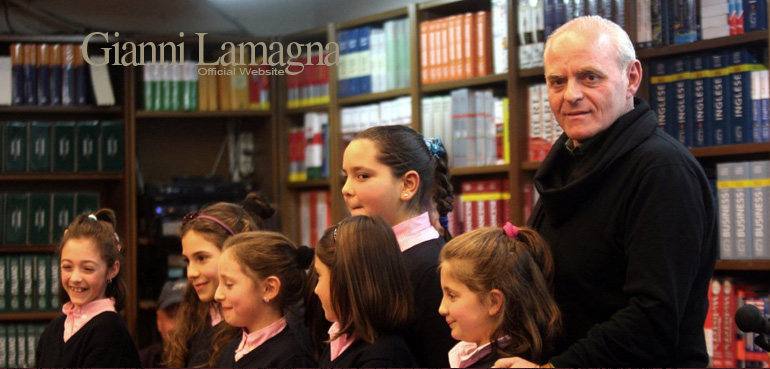

... Gianni Lamagna is an artist of the 19th century lost in the contemporary world. I have never known more human and more stubborn, more elegant and more coarse, more ambiguous and more linear person and all that on the same time and with a voice that allows him to sing with the same boldness Schoenberg and Gaetano Lama, Goethe and Libero Bovio. In the force of his interpretations, there's the secret of someone who loves the music from the most remote folds of his soul, without any forcing of diva.
His most beautiful quality: the generosity...... One needs to understand that the Neapolitan cultural heritage, in which we have to include who does really make culture, has remained, by virtue of some strange alchemy, submerged and Gianni Lamagna is really and truly an example of "high" musical culture. His continual research onto the voice, his way of experimenting new directions, has yielded results that are very much living and widespread…
... Gianni Lamagna reveals a suppleness, an acute sense of eclecticism that only his exceptional voice knows how to unify. Amate Cantate, in the voice of Gianni Lamagna, between honey and Greek tragedy, sings the warmth of the weather and the weeping of angels...
... Gianni Lamagna and Antonello Paliotti, working side by side, have elaborated a project that has effectively succeeded in distancing the interpretation from the model used abusively...
... Lamagna, accompanied by the Colin Muset Ensemble and his Concertino offers a lesson in interpretative eclecticism ranging from tha pieces by Viviani to popular songs, from the foundations of the classic Neapolitan song to pieces that are less universally known and, maybe for that reason, even more deserving to be rediscovered...
... and finally the moment of Bambenella arrives unleashing the phenomenal talent of Gianni Lamagna, who has earned personal and well-deserved success that reverberates on the performance as a whole...
... with the passion and the fervour of one initiated in esoteric doctrines Gianni Lamagna guides, explains and “reveals” his truths, and his stories, justifies the choices of the interesting re-elaborations, the highly particular arrangements by Antonello Paliotti, and sings...
... He reviews the Neapolitan Song, in front of us, but this time it is not drenched in the usual attitudes. At certain moments, you can almost make out a resonance close to that of Strawinskij, or a rhythm that strays into other “continental” dimensions: from Astor Piazzolla to Inti Illimani, right up to a certain modern percussionism...
... a driving thematic thread is decidedly absent. We need, here, to retrace a mental process in which the specifics of a genre no longer counts, but, rather, renewed presentation. The memory, then, is the protagonist; the taste for a “perpetual return” as if going back to a source from which to collect pure water, free of any contamination. Di Giacomo's Era di Maggio, or Core ‘ngrato are not all that far remote from that Menta Cedra and Nanassa that are “musically” performed with irony and fun...
... The songs, hand in hand, turned into a multitude of short stories, like “one-act” pieces that synthesized the tragedies in a brief instant. A song, just like a poem, requires that moment of culminating action, the soul of an emotion. And all of this seems clear to us after having attended Gianni Lamagna's concert, S’io Fosse...
... but there is still room for tenderness and melancholy (Gianni Lamagna is splendid in Vurria addeventà nu suricillo elaborated by the NCCP on Apulian traditional sounds (Tarantelle del Gargano)...
... in reality, the true Neapolitan Song, was written and sung for a city that no longer exists, a city destroyed both physically and anthropologically: there are no longer those particular conditions that, for centuries, inspired the poetry of the songs, and the styles of traditional songs have been forgotten in order to follow new fashions
What we need now is silence; that would allow us not to hear the too many confused, degrading and debasing voices. We could then go back to that city and lose ourselves in the meanderings of its history and its genuine legends, among the great writers and performers, but with the somewhat painful knowledge that, in reality, that world can never come back, unless it’s in the miraculous form of a great voice singing.... A musical operation of big artistic value, this I Cottrau a Napoli, that Gianni Lamagna, incontestable interpreter of the big Neapolitan popular tradition, offers to the history of his city...
... Through the eighteen pieces, Lamagna browses, with a particular sensitivity, the repertoire of the songs of the Cottrau with the style, non common, of one who knows how to give the energy to the interpretation but without shouting. A beautiful concert, and a beautiful opportunity to shine and to continue to maintain lit the fire of the art...
... The big musical passion that characterizes Gianni Lamagna allowed him to interpret to best the pieces of the Cottrau with a cool and powerful voice worthy of the big interpreters of the beginning of the 20th century...
... a CD and a concert to listen to a voice and a music without time, an opportunity to know in depth the extraordinary artistic and musical heritage of the city of Naples...
... it is sufficient to listen with a argued calmness the precious homage that a rigorous singer as Gianni Lamagna wanted to engrave on a CD,I Cottrau a Napoli, to discover an excellent, simple interpretation that doesn't let itself ever go to vain baroque virtuosity...
... a voice of an extraordinary intensity that moves of once to the other on a reinvented musical background, through refined arrangements, and that finishes by suggesting interpretations considerably faraway of the traditional models of the Neapolitan Song.
... after thirty years of career based on a big will to look at himself in the infinite sea of the Neapolitan musical heritage, Gianni Lamagnashows an insatiable "thirst" again to experiment new ways for music and the theater.
... the Forme Incantate is a big concert, a great Lamagna with original and surprising arrangements, in this the Lamagna-Paliotti association is part of the most interesting ones of the moment regarding to the valorization of a Neapolitan Song far from all oleography.
... Gianni Lamagna wanted to pursue his thirtieth year of research in the domain of the Neapolitan music with a heterogeneous and original work that rediscovers songs of the tradition among the most known and at the same time to reinterpret big partenopean success.
The “Forme” want to recall the diversity of the artistic expressions mingled in scientists compositions of odd and melancholic atmospheres and fantasies more happy and popular. The Forme Incantate bring back us to the shapes of our identity that are a lot more varied than we think it, a historic exercise, therefore, not to forget our origins that however resident in the lightness of some chords of guitar and a special, intense voice.The ingredients were all united to give life to a big evening of spectacle in the court of the Maschio Angioino with the talented and fickle artist Gianni lamagna, the musical direction of Antonello Paliotti, the participation of Totò's daughter, Liliana De Curtis, the presence of the mayor of Naples and a big crowd. Such is the preamble of the big Concerto per un Principe, a feast in music that celebrated Totò, artist unique to the world, for the fortieth anniversary of his death.
An excellent Gianni Lamagna that has surpassed himself, between narration and bel canto, was with his "Totò" the protagonist of the evening, during which took life music and poetry of the big comedian, poet, actor, author and musician.
A concert of true musical rejoicing and melancholic reflections for a long time applauded by a numerous public among which many Neapolitan artists and institutional personalities.TEXTS BY: A. Orselli, M. Della Felba, P. Monti, F.Chiari, A. Paliotti, F. Vacalebre, S. Albertini, F. Parrot, A. Savioli. S. Di Maio, A. Billwiller, G. Capurro, M.G. Poggiagliolmi, S. de Stefano, G. Giorgio, A. Stromillo, S. Piedimonte, R. D’Agostino, A. Finizio .